



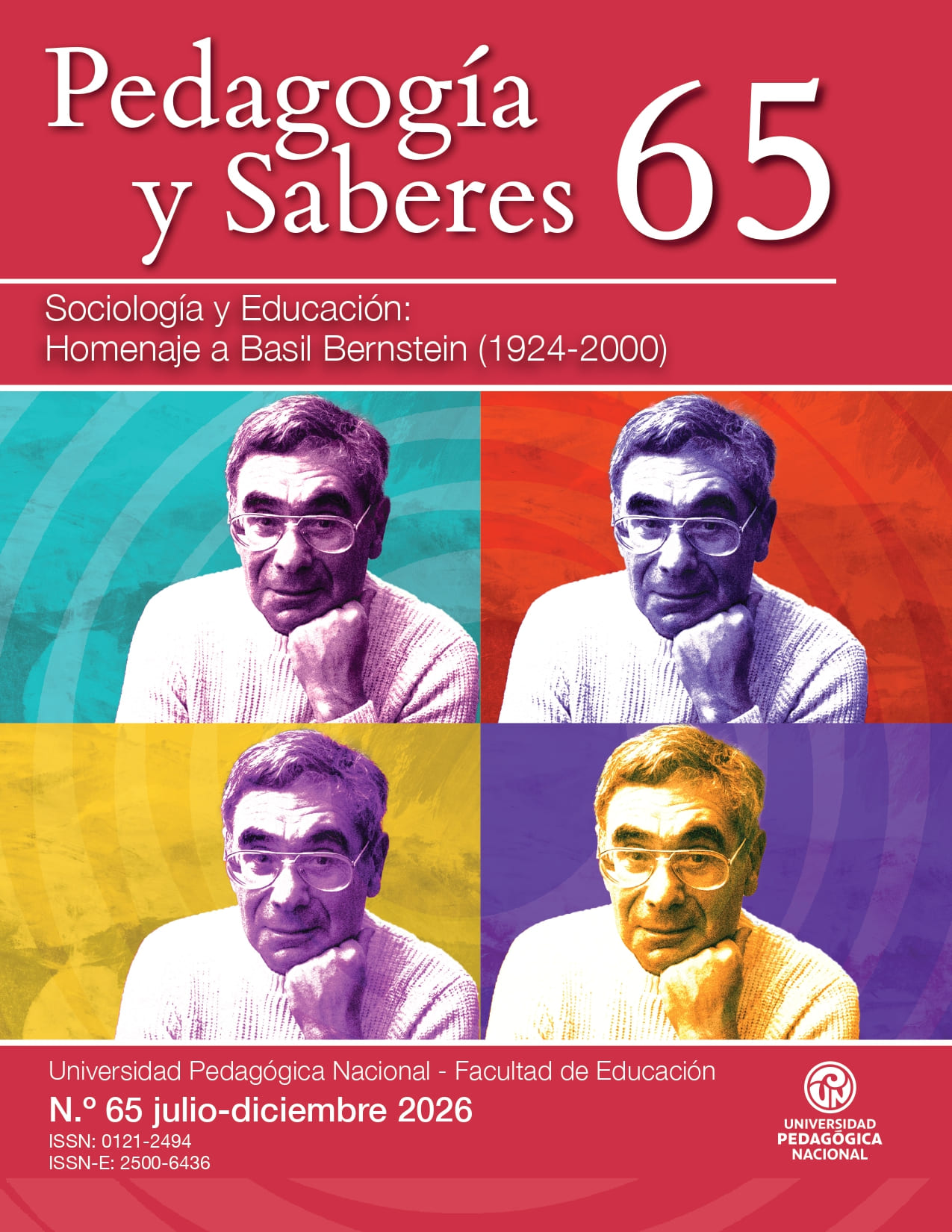
Estructura y poder en la práctica pedagógica: un análisis desde Bernstein
Resumen
Escuche el resumen aquí: Audio Abstract
Este artículo de reflexión aborda la práctica pedagógica desde la teoría sociológica de Basil Bernstein y de quienes han aplicado tu teoría. Busca trascender la segmentación conceptual que caracteriza a los estudios pedagógicos contemporáneos, generalmente centrados en modelos empíricos cualitativos y cuantitativos. La multiplicidad de enfoques —conductista, constructivista, hermenéutico, fenomenológico o humanista, entre otros— ha generado discursos sectorizados que limitan la comprensión de la práctica pedagógica a lo que ocurre en el aula y al desempeño técnico o instrumental del docente. Esta visión contextualista privilegia la descripción de lo que el maestro hace, dejando de lado la estructura de relaciones sociales que sostiene toda práctica pedagógica. A partir de la teoría de las transmisiones educativas, el artículo analiza la gramática interna que produce los códigos pedagógicos, regulando posiciones, disposiciones, prácticas e identidades. El artículo plantea que los diversos enfoques metodológicos constituyen un “código agregado” que oculta la estructuración interna de la práctica pedagógica y dificulta su comprensión en términos de poder, control y transmisión cultural. Si bien el texto busca ofrecer una perspectiva no subjetiva, en la que la pedagogía es entendida como un dispositivo estructural de regulación y producción de conciencia, más allá del punto de vista particular de quien la formula, no significa incrustar a Bernstein dentro del estructuralismo.[1]
[1] Este artículo es una reflexión no derivada de investigación que revisa el tema de la práctica pedagógica a partir de las tesis de Basil Bernstein y sistematiza las reglas de la práctica pedagógica.
Citas
Barnett, R. (1990). The Idea of Higher Education. Society for Research into Higher Education & Open University Press.
Bernstein, B. (1973). La estructura del discurso pedagógico. Morata.
Bernstein, B. (1975). Class, Codes and Control. Vol. 3. Towards a Theory of Educational Transmissions. Routledge & Kegan Paul.
Bernstein, B. (1990). Poder, educación y conciencia: sociología de la transmisión cultural. El Roure.
Bernstein, B. (1993). La estructura del discurso pedagógico. Clases, códigos y control (v. 4). Morata.
Bernstein, B. (1998). Pedagogía, control simbólico e identidad. Teoría, investigación y crítica. Morata.
Bernstein, B. (2001). From Pedagogies to Knowledges. En A. Morais, I. Neves, B. Davies y H. Daniels (eds.), Towards a Sociology of Pedagogy: The Contribution of Basil Bernstein to Research. Peter Lang.
Bourdieu, P., y Passeron, J.-C. (1964). Les héritiers: Les étudiants et la culture. Les Éditions de Minuit. DOI: https://doi.org/10.1515/9783112319161
Bourdieu, P. y Passeron, J.-C. (1970). La reproduction: Éléments pour une théorie du système d’enseignement. Les Éditions de Minuit.
Bourdieu, P. y Passeron, J. C. (1970). Los herederos: los estudiantes y la cultura. Les Éditions de Minuit.
Bruner, J. S. (1978). El proceso de la educación. Aguilar.
Collins, R. (2005). Interaction Ritual Chains. Princeton University Press. DOI: https://doi.org/10.1515/9781400851744
Daniels, H. (1989). Visual Displays as Tacit Relays of the Structure of Pedagogic Practice. British Journal of Sociology of Education, 10(2), 123-140. https://doi.org/10.1080/0142569890100201 DOI: https://doi.org/10.1080/0142569890100201
Dewey, J. (2008 [1916]). Democracia y educación: introducción a la filosofía de la educación. Morata.
Díaz-Villa, M. (1990). De la práctica pedagógica al texto pedagógico. Pedagogía y Saberes, 1, 14-27. https://doi.org/10.17227/01212494.1pys14.27 DOI: https://doi.org/10.17227/01212494.1pys14.27
Díaz-Villa, M. (2007). Flexibilidad y educación superior. La educación superior frente a los retos de la flexibilidad. Magisterio.
Eisner, E. W. (1987). La educación y el arte de la enseñanza. Paidós.
Foucault, M. (1970). Qu’est-ce qu’un auteur? Bulletin de la Société Française de Philosophie, 63(3), 73-104.
Freinet, C. (1977 [1946]). Nuevas técnicas de enseñanza. Laia.
Freire, P. (2003 [1970]). Pedagogía del oprimido. Siglo XXI.
Giroux, H. A. (2020). On Critical Pedagogy. Bloomsbury Academic. DOI: https://doi.org/10.5040/9781350145016
Gore, J. M. (1992). Controversias entre las pedagogías: discursos críticos y feministas como regímenes de verdad. Morata.
Graizer, O. L. y Navas-Saurin, A. (2011). El uso de la teoría de Basil Bernstein como metodología de investigación en didáctica y organización escolar. Revista de Educación, 356, 133-158. https://www.educacionyfp.gob.es/revista-de-educacion/numeros-revista-educacion/numeros-anteriores/2011/re356/re356-06.html
Gramsci, A. (1948-1951). Cuadernos de la cárcel. Instituto Gramsci.
Guijarro-González, S. (2008). El saber de los claustros: las escuelas monásticas y catedralicias en la Edad Media. ARBOR. Ciencia, Pensamiento y Cultura, 184(731), 443-455. https://doi.org/10.3989/arbor.2008.i731.195 DOI: https://doi.org/10.3989/arbor.2008.i731.195
Hordern, J. (2021). Why Close to Practice is not Enough: Neglecting Practice in Educational Research. British Educational Research Journal, 47(6), 1451-1465. https://doi.org/10.1002/berj.3622 DOI: https://doi.org/10.1002/berj.3622
Hegel, G. W. F. (1998 [1816]). Escritos pedagógicos. Fondo de Cultura Económica.
Herbart, J. F. (1923). Pedagogía general derivada del fin de la educación. La Lectura.
Illich, I. (1971). La sociedad desescolarizada. Harper y Row.
Jaeger, W. (2004 [1933]). Paideia: los ideales de la cultura griega. Fondo de Cultura Económica.
Kant, I. (2003 [1803]). Pedagogía. Akal.
Maldonado-Díaz, C. (2022). Estudio del discurso pedagógico: enfoque bernsteniano clásico y revisiones actuales sobre un modelo de análisis para la investigación de la pedagogía puesta en acto. Revista de Estudios y Experiencias en Educación, 21(45), 409-431. https://doi.org/10.21703/0718-5162.v21.n45.2022.021 DOI: https://doi.org/10.21703/0718-5162.v21.n45.2022.021
Mauss, M. (2002 [1926]). Manual de etnografía. http://bibliotheque.uqac.uquebec.ca/index.htm
McLaren, P. (2006). La vida en las escuelas: una introducción a la pedagogía crítica en los fundamentos de la educación. Graó.
Moore, R. (2013). The Thinker and the Field. Routledge and Kegan Paul.
Morais, A. M., Barradas, H., Rainha, H. y Pestana-Neves, I. (1986). A teoria de Bernstein em sociologia da educação. Fundação Calouste Gulbenkian.
Piaget, J. (2001). Psicología y pedagogía. Ariel.
Ricoeur, O. (2008). Hermenéutica y acción: de la hermenéutica del texto a la hermenéutica de la acción. Prometeo.
Sadovnik, A. R. (1992). La teoría de la práctica pedagógica de Basil Bernstein: un enfoque estructuralista. Investigación en la Escuela 17, 7-29. https://doi.org/10.12795/IE.1992.i17.01
Tadeu da Silva, T. (1999). Documentos de identidad: una introducción a las teorías del currículo. Autêntica.
Unesco. (2015). Education for all 2000-2015: Achievements and challenges. Unesco Publishing.
Vergara-Ciordia, F. J. (1999). El aprendizaje en la Edad Media [entrevista]. Educación en Radio 3. https://uned-p-dls2.teltek.es/downloads/2152/81922.m4a
Vygotsky, L. S. (1979 [1934]). Pensamiento y lenguaje. El desarrollo de los procesos psicológicos superiores. Crítica.
Willis, P. (1977). Learning to Labour: How Working-Class Kids Get Working Class Jobs. Saxon House.
Descargas
Derechos de autor 2026 Pedagogía y Saberes

Esta obra está bajo una licencia internacional Creative Commons Atribución-NoComercial 4.0.


